
If you’re wondering whether it’s time to upgrade your electrical panel, you’re not alone. Many homeowners start searching for questions to ask electrician panel upgrade when they notice electrical issues or plan upgrades like an EV charger or home renovation. One of the most common factors electricians evaluate is whether your current service, often 100 amps, can still support modern electrical demand or if moving to 200 amps is the safer long‑term solution. Before you call an electrician, a few key questions can help you better understand your situation and make a smarter decision. In this guide, we’ll walk through the most important ones, so keep reading.
Questions to Ask Electrician Before a Panel Upgrade
Before moving forward with a panel upgrade, take a moment to ask the right questions to ask electrician panel upgrade. Clear answers about scope, permits, costs, and capacity will help you avoid surprises and make a confident decision.
Question 1: What Is My Current Electrical Service Capacity?
Before thinking about a panel upgrade, the first step is understanding how much electrical capacity your home currently has. Many homeowners call an electrician without knowing whether their service is 60 amps, 100 amps, or 200 amps, yet this single number often determines whether an upgrade is necessary.
Electrical service capacity refers to the maximum amount of electricity your home can safely draw from the utility grid at one time. In older houses, 60‑amp or 100‑amp services were common because homes simply didn’t use as much electricity as they do today. Modern households with EV chargers, electric heating systems, and larger appliances often require 200‑amp service to operate safely and reliably.
Checking your existing capacity only takes a minute, and it gives you a clearer starting point before asking an electrician about a panel upgrade.
How to Check Your Main Breaker
Your electrical service size is determined by the main breaker in your panel. This breaker controls the total power entering the house.
You can usually find the rating in a few simple steps:
- Open your electrical panel door.
- Look for the largest breaker, typically located at the top or bottom of the panel.
- The amperage rating is printed directly on the switch handle.
Common markings include:
- 60
- 100
- 125
- 150
- 200
If the label reads 100, you have a 100‑amp service. If it shows 200, your home already has the higher‑capacity service used in most newer properties.
If you’re unsure what you’re looking at, it’s worth having a professional confirm it during an electrical inspection. Homeowners who notice unusual electrical behavior often start investigating their panel while troubleshooting problems such as flickering lights, which can sometimes indicate that the system is under electrical strain.
60 Amp vs 100 Amp vs 200 Amp Service
Each service size reflects a different era of residential electrical demand. The table below shows how they generally compare in practical terms.
| Service Size | Typical Home Type | Limitations |
| 60 Amp | Very old homes with fuse panels | Often insufficient for modern appliances |
| 100 Amp | Many homes built before the 2000s | Can struggle with EV chargers or major additions |
| 200 Amp | Modern homes and major renovations | Supports EV charging, heat pumps, hot tubs, and larger loads |
Most electricians today recommend 200‑amp service when homeowners plan to add significant electrical loads. The extra capacity provides flexibility for future upgrades and reduces the risk of overloaded circuits.
Once you know your service capacity, the next question becomes just as important: is there actually room left in the panel to add new circuits?
Question 2: Is My Electrical Panel Already Full?
Service capacity is only part of the equation. Even if your home has a 100‑amp or 200‑amp service, the physical space inside the panel can still become a limitation.
Every electrical panel has a fixed number of breaker slots. Each circuit in your home occupies one of those slots. As homeowners add appliances, renovate rooms, or install new equipment, electricians often need to add new circuits. When the panel runs out of available spaces, adding more circuits becomes difficult or unsafe.
A full panel is one of the most common reasons homeowners start researching questions to ask electrician panel upgrade. If there is no room left for additional breakers, an upgrade or panel replacement may be necessary before any new electrical work can be completed.
Signs Your Panel Has No Room for New Circuits
A quick visual check of your panel can reveal whether space is becoming a problem. Look for these indicators:
- All breaker slots are occupied
- If every position in the panel already has a breaker installed, there is no available space for new circuits.
- Use of tandem or “double” breakers
- Electricians sometimes install tandem breakers to fit two circuits into one slot. While this can be acceptable in certain panels, widespread use often signals that the panel is reaching its limits.
- Multiple rooms sharing a single circuit
- Kitchens, garages, and workshops often need dedicated circuits. If many areas of the home are sharing breakers, the system may already be stretched.
- New installations requiring additional circuits
- Projects such as EV charger installations, hot tubs, or large appliances often require their own dedicated breaker. For example, a garage EV charger installation typically needs a dedicated high‑capacity circuit.
When an electrician opens a crowded panel, they usually evaluate two things: whether the panel has space for additional breakers and whether the existing electrical service can safely handle the extra load. If either limit has been reached, the discussion usually turns toward a panel upgrade.
Question 3: Am I Planning High‑Power Additions to My Home?
A panel that works fine today might struggle tomorrow if your electrical demand increases. Many homeowners only start thinking about a panel upgrade when they plan to install equipment that draws a large amount of power.
Electricians often ask about future plans for the home, not just current usage. The reason is simple. If major electrical loads are coming soon, it makes more sense to upgrade the panel once rather than make multiple smaller changes later.
When people search for questions to ask electrician panel upgrade, this is one of the most important ones to consider. Certain additions almost always trigger a discussion about electrical capacity.
EV Chargers
Electric vehicles are one of the biggest drivers behind panel upgrades today.
A typical Level 2 EV charger can draw between 32 and 48 amps, and it often runs for several hours at a time while the vehicle charges overnight. In a home with a 100‑amp panel, adding this load can push the system close to its safe operating limit.
Many electricians perform a load calculation before approving the installation. If the numbers are too tight, they will recommend moving to a 200‑amp service.
Homeowners planning to charge their vehicles at home usually start by understanding the electrical requirements of the installation. Projects like running wiring for a garage EV charger often reveal whether the existing panel has enough available capacity.
Heat Pumps
Heat pumps are becoming increasingly common across British Columbia as homeowners switch to more energy‑efficient heating and cooling systems.
Unlike traditional gas furnaces, heat pumps rely entirely on electricity. Depending on the size of the system, they can add a significant continuous load to your electrical panel.
Situations where upgrades are commonly required include:
- Converting from gas heating to an all‑electric heat pump system
- Installing larger multi‑zone heat pumps
- Adding electric backup heating
In many cases, electricians recommend evaluating the panel capacity before installation begins.
Hot Tubs
Hot tubs are another upgrade that frequently exposes electrical limitations.
Most residential hot tubs require a dedicated 240‑volt circuit, often between 40 and 60 amps. This circuit cannot be shared with other appliances, which means the panel must have both available space and sufficient electrical capacity.
The electrical work involved can vary depending on the distance from the panel, wiring route, and local code requirements. Homeowners often explore the hot tub electrical installation cost in Metro Vancouver before committing to the project because the panel capacity can influence the total installation scope.
Basement Suites
Adding a basement suite changes the electrical demands of a home more than many people expect. A legal suite typically includes:
- A full kitchen
- Additional lighting circuits
- Dedicated outlets
- Laundry appliances
- Heating or ventilation equipment
Each of these requires new circuits, and in some cases the total load may exceed what a 100‑amp service can comfortably support.
Electricians evaluating a suite conversion usually perform a full load calculation to determine whether the existing panel can support the additional electrical demand or if a panel upgrade will be required.
Question 4: Are There Warning Signs of Electrical Overload?
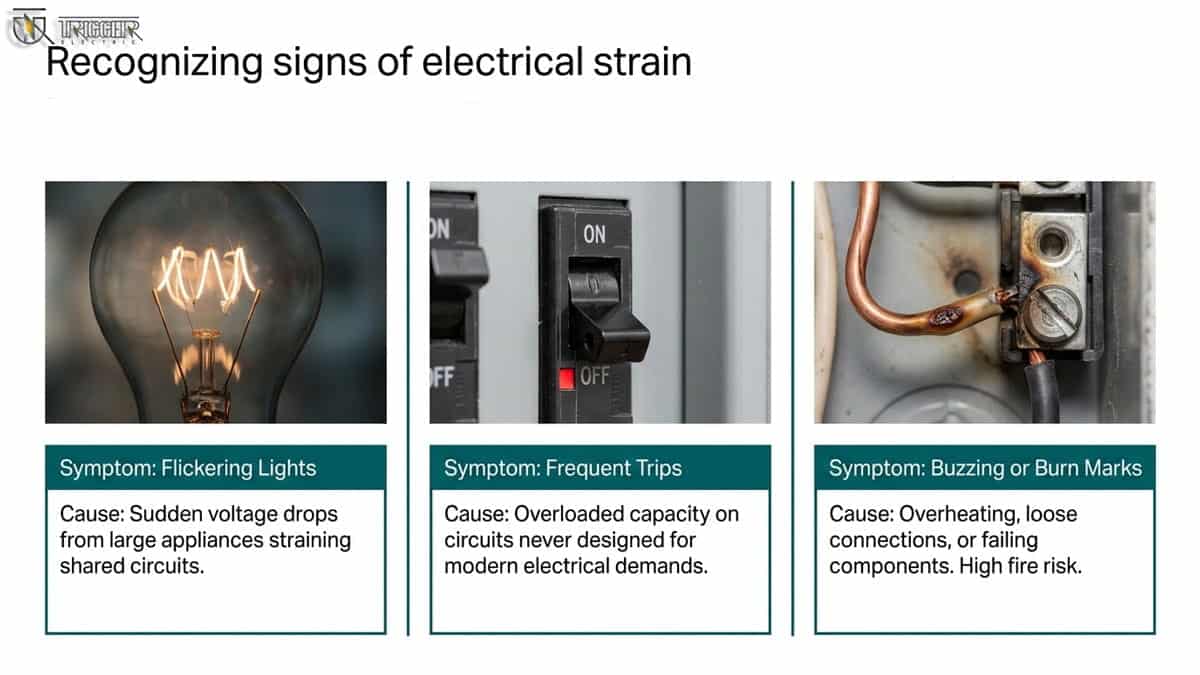
Electrical systems rarely fail without warning. Long before a panel becomes unsafe, the system usually shows small signs that circuits are under stress or operating near their limits.
Homeowners often notice these symptoms but assume they are minor issues. In reality, they can indicate that the panel is struggling to handle the electrical demand in the house. Recognizing these warning signs early helps you ask the right questions to ask electrician panel upgrade before a small issue turns into a serious electrical hazard.
Flickering Lights
Lights that flicker when appliances start running are one of the most common indicators of electrical strain.
This often happens when large appliances such as microwaves, space heaters, or vacuum cleaners draw power from the same circuit as lighting. The sudden demand can cause a brief voltage drop that makes the lights dim or flicker.
Occasional flickering might not be serious, but consistent or widespread flickering across multiple rooms deserves attention. Situations like this are often investigated when homeowners begin troubleshooting flickering lights in their home, especially in older electrical systems.
Frequent Breaker Trips
Circuit breakers are designed to trip when a circuit draws more current than it can safely handle. An occasional trip is normal. Repeated trips are not.
Common causes include:
- Too many appliances connected to the same circuit
- High‑demand devices running simultaneously
- Circuits that were never designed for modern electrical loads
If breakers trip regularly, the panel may be reaching its practical limit. An electrician will usually check both the circuit layout and the overall panel capacity before recommending a solution.
Burn Marks or Buzzing
Physical signs inside or around the panel should never be ignored. These may indicate overheating, loose connections, or failing components.
Watch for:
- Discoloration or burn marks near breakers
- A persistent buzzing or humming sound from the panel
- Breakers that feel unusually warm
- A faint burning smell near the electrical panel
These symptoms can signal a serious electrical issue. When they appear, a professional inspection should be scheduled as soon as possible to determine whether the panel itself needs repair or replacement.
Question 5: Is My Panel Brand Outdated or Unsafe?
Not all electrical panels age the same way. Some older panel brands developed well‑documented safety problems over time, especially related to breakers failing to trip during overloads. When that happens, the wiring in the home can overheat without the protection the breaker is supposed to provide.
For electricians, the brand and type of panel often becomes a key factor during a service visit. Even if the panel appears to work normally, certain models are widely considered unsafe or outdated and are frequently recommended for replacement.
Homeowners researching questions to ask electrician panel upgrade are often surprised to learn that the panel brand itself can be enough to justify an upgrade.
Federal Pacific
Federal Pacific Electric panels, often labeled FPE or Stab‑Lok, were installed in many homes between the 1950s and 1980s.
The concern with these panels is not just their age. Numerous inspections and field reports have shown that some Stab‑Lok breakers fail to trip during overload or short circuit conditions. When a breaker fails to trip, the circuit can continue drawing excessive current, which increases the risk of overheating and electrical fires.
Because of these issues, many electricians recommend replacing Federal Pacific panels when they are found during an inspection.
Zinsco
Zinsco panels were also widely used in mid‑century homes. Over time, electricians discovered several design problems that affect reliability.
Common issues include:
- Breakers that fail to disconnect power during faults
- Corrosion inside the panel that damages the bus bars
- Breakers that appear switched off but still allow electricity to flow
These problems can make the panel unreliable as a safety device. When a Zinsco panel is identified, most electricians recommend a full panel replacement rather than attempting repairs.
Old Fuse Panels
Fuse panels were common in homes built before modern breaker panels became standard. Instead of resettable breakers, these systems use screw‑in fuses that must be replaced when they blow.
While fuse systems can technically function safely when maintained properly, they create several practical and safety concerns today:
- Limited electrical capacity, often around 60 amps
- Difficulty supporting modern appliances
- Higher insurance scrutiny
Insurance companies frequently view older electrical systems as a higher risk. In some cases, outdated wiring systems such as knob and tube wiring or fuse panels can make it harder to obtain or maintain home insurance coverage.
When a home still relies on a fuse panel, upgrading to a modern breaker panel is usually the safest and most practical solution.
Question 6: Will My Home Insurance Require an Upgrade?
Your electrical panel does not just affect safety. It can affect whether your home is insurable.
Insurance companies assess fire risk, and outdated electrical systems raise red flags. If your panel is old or undersized, your insurer may require an upgrade before approving or renewing coverage.
This is often when homeowners begin asking serious questions to ask electrician panel upgrade.
Insurance Restrictions for Fuse Panels
Fuse panels are a common concern for insurers.
Why?
Because fuses can be incorrectly replaced with higher‑rated ones, removing proper overload protection. Many insurers respond by requiring:
- Replacement with a modern breaker panel
- A professional electrical inspection
- Proof that the system meets current safety standards
Homes with older systems like knob‑and‑tube or aluminum wiring may face similar scrutiny.
Insurance Benefits of 200 Amp Service
Insurance companies rarely demand 200 amp service specifically. However, a modern 200 amp panel signals that the home can safely handle today’s electrical loads.
This matters if you have:
- An EV charger
- Electric heating or heat pumps
- A hot tub
- A secondary suite
A properly sized, updated panel reduces risk in the eyes of insurers and can prevent complications during policy renewal.
Question 7: Do I Need a Panel Upgrade or a Service Upgrade?
Homeowners often use the term panel upgrade for any electrical improvement, but electricians usually separate two different things: replacing the panel or increasing the electrical service capacity. Knowing the difference helps when discussing questions to ask electrician panel upgrade, because the work involved can be very different.
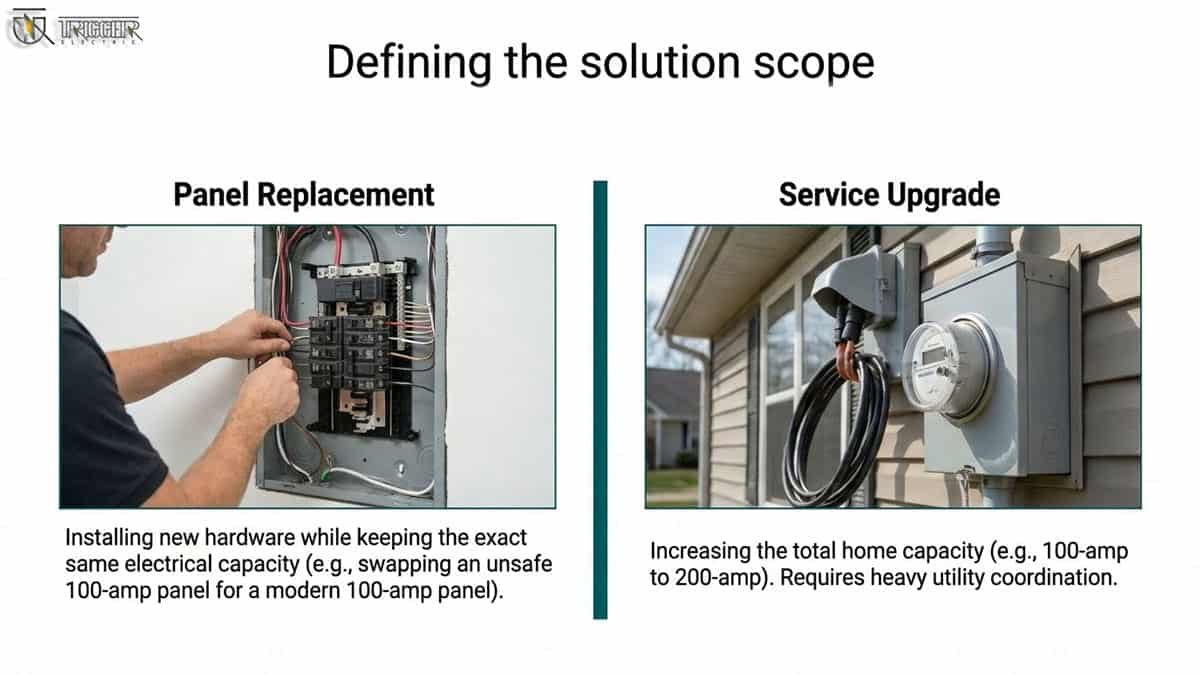
Panel Replacement vs Service Upgrade
A panel replacement means installing a new breaker panel while keeping the same electrical capacity. For example, replacing an old or unsafe 100 amp panel with a new 100 amp breaker panel.
A service upgrade increases the home’s electrical capacity, most commonly from 100 amp to 200 amp service. This is often needed when adding high‑power equipment such as EV chargers, heat pumps, or a basement suite.
Utility Coordination
Service upgrades usually require coordination with the local utility. The power may need to be temporarily disconnected, inspected, and then reconnected after the work is complete. Electricians typically manage this process as part of the upgrade.
Conclusion
Upgrading your electrical panel is an important step in keeping your home safe and prepared for modern power demands. By asking the right questions to ask electrician panel upgrade, you can better understand the scope of work, costs, permits, and whether your home needs a simple panel replacement or a full service upgrade. If you’re planning a panel upgrade or want expert guidance on the right option for your home, explore our panel upgrade service and get professional help to ensure your electrical system is safe, efficient, and future‑ready.