

A hot tub is one of the easiest upgrades to get wrong electrically. Between the voltage, the water, and BC’s strict code requirements, a proper Hot Tub Electrical Requirements in BC involves far more than running a wire from the panel to the tub. At Trigger Electric, we handle every part of that process for homeowners across Metro Vancouver, from sizing the circuit correctly to making sure the final setup passes inspection without a second visit.
Hard-Wired vs. Plug-and-Play: Which Setup Does Your Hot Tub Need?
Not every hot tub needs the same electrical setup. Before any wiring decisions get made, it helps to know which category your unit falls into.
Plug-and-play hot tubs run on a standard 120V/15-20A circuit with a GFCI-protected outlet. They’re simpler to install, but that simplicity comes with a tradeoff: most plug-and-play models can’t run the heater and the jets at full power at the same time.
Hard-wired hot tubs run on a dedicated 240V circuit, typically rated between 40 and 60 amps depending on the tub’s pump and heater configuration. There’s no plug involved. The electrician connects the unit directly to a breaker in your panel, which gives you steadier heating and full jet performance without the circuit struggling to keep up.
| Plug-and-Play (120V) | Hard-Wired (240V) | |
|---|---|---|
| Circuit type | Standard GFCI outlet | Dedicated GFCI breaker |
| Typical amperage | 15-20A | 40-60A |
| Heater + jets together | Limited | Full performance |
| Installation complexity | Lower | Higher, requires licensed electrician |
| Best for | Smaller or portable spas | Most residential hot tubs |
Most hot tubs sold for permanent backyard use fall into the hard-wired category. Before scheduling delivery, it’s worth checking your owner’s manual or asking your retailer which voltage and amperage your specific model requires.
That number determines everything else about the Hot Tub Electrical Requirements in BC, including whether your existing panel can handle the load.
The Electrical Requirements Behind a Safe Hot Tub Setup
A hot tub puts electricity and water in close proximity, which is exactly why BC’s Electrical Code treats Hot Tub Electrical Requirements in BC as its own category of work, not a generic appliance hookup. Four elements determine whether that setup is actually safe.
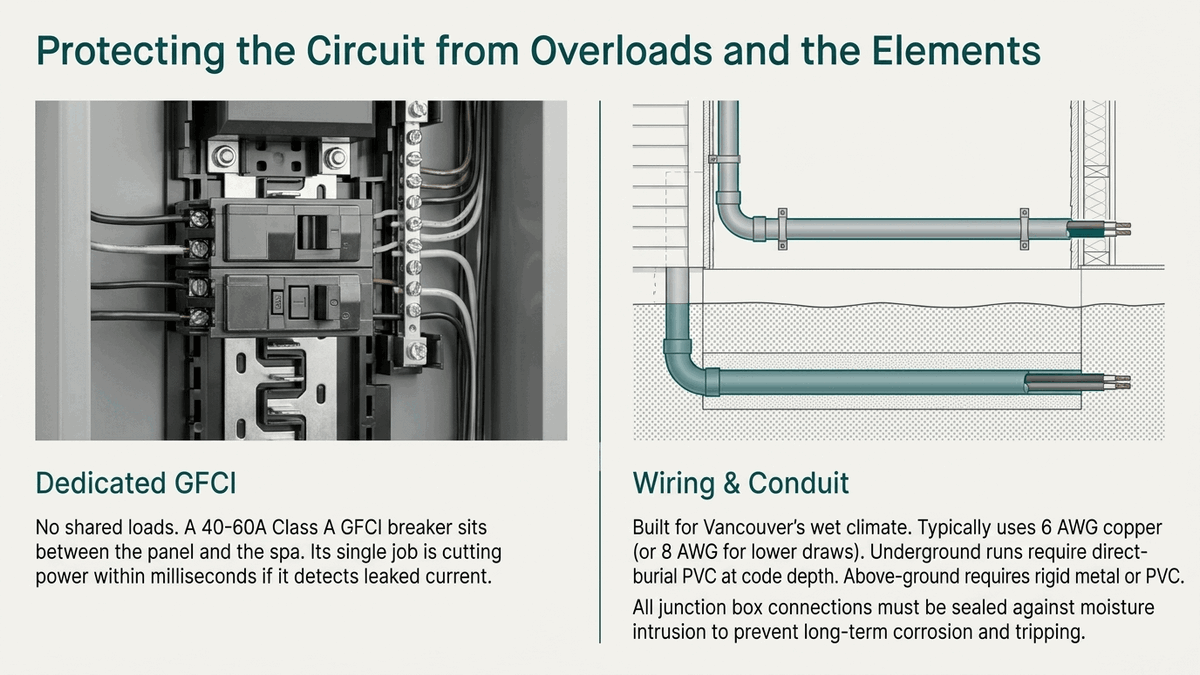
Dedicated Circuit & GFCI Protection
Your hot tub needs its own circuit, with nothing else sharing the load. A Class A GFCI breaker rated for the tub’s voltage and amperage sits between the panel and the spa, and it has one job: cutting power the moment it detects current leaking somewhere it shouldn’t. This isn’t a recommendation. It’s required for any Hot Tub Electrical Requirements in BC under the Canadian Electrical Code, and any inspector will check it first.
Wiring, Conduit & Weatherproofing
The wire gauge depends on the circuit’s amperage; most 240V hot tubs run on 6 AWG copper, though some lower-draw setups can use 8 AWG. Whatever the size, the cable needs to be rated for outdoor and wet locations, and it has to run through conduit for its entire path to the tub.
- Underground runs call for PVC conduit rated for direct burial, buried at the proper code depth
- Above-ground runs typically use rigid metal or PVC conduit, secured and protected from impact
- All connections at the tub’s junction box need to be sealed against moisture intrusion
Vancouver’s wet climate makes this step less forgiving than it would be elsewhere. A conduit fitting that’s loose or improperly sealed will let moisture in eventually, and corrosion at a wire connection is one of the more common reasons a hot tub circuit starts tripping months after a sloppy install.
Bonding & Grounding
This is the step homeowners tend to overlook and the one inspectors scrutinize most closely. Every metal part of the hot tub, including pumps, heaters, and any metal framing, has to be bonded together and back to ground. If the tub sits on a concrete pad, the code typically requires bonding the rebar in that pad as well; where there’s no rebar, an equipotential bonding grid using No. 6 AWG copper wire goes in around the perimeter instead. The purpose is straightforward: without it, different metal parts near the tub can sit at slightly different voltages, and that voltage gradient is what creates a shock risk for someone standing in or near the water.
Disconnect Switch Placement
Every hard-wired hot tub needs an emergency disconnect, sometimes called a spa panel, mounted within sight of the tub. BC code requires it to be at least 1.5 metres from the water’s edge but still visible and reachable without walking around the house to find it. In an emergency, someone needs to be able to kill power to the tub in seconds, not after searching the yard for a breaker box.
Does Your Panel Have Enough Capacity?
A 240V circuit is the backbone of any Hot Tub Electrical Requirements in BC, and it adds a meaningful load to your home’s electrical system that not every panel has room for. This is the step that gets skipped most often, usually because the homeowner assumes “the panel’s fine” without actually running the numbers.
A few things determine whether your panel can take on a hot tub without issue:
- Available capacity: Most homes run on 100A or 200A service. Older 100A panels with several existing high-draw circuits (range, dryer, EV charger) may already be close to their limit.
- Panel age and condition: Panels installed before the 1990s sometimes use breaker types or busbar configurations that don’t accommodate a new 40-60A double-pole breaker cleanly.
- Available physical space: Even a panel with electrical headroom needs an open slot for the new breaker.
If the load calculation shows your panel is maxed out, the fix isn’t to squeeze the hot tub circuit in anyway. It’s a panel upgrade. We’ve covered the signs that point to this in more detail in our guide on what to ask before calling an electrician about a panel upgrade, but the short version is that an undersized or overloaded panel doesn’t just risk nuisance tripping. It’s a fire hazard, and it’s one of the first things an inspector flags.
This is also where a site evaluation earns its place in the process. Before any Hot Tub Electrical Requirements in BC begins, we check your existing service, run the load calculation, and tell you upfront whether your panel can handle the hot tub as-is or whether an upgrade needs to happen first.
Permits and Inspection: Not Optional in BC
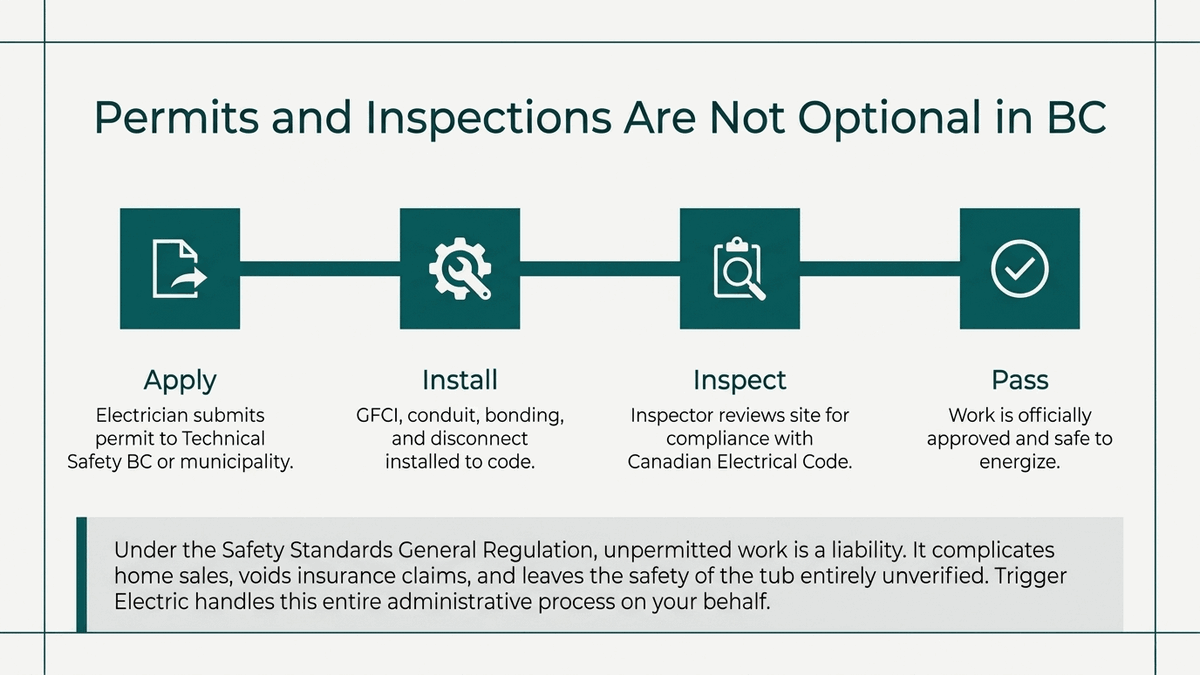
Every Hot Tub Electrical Requirements in BC a permit. This is regulated work under the Safety Standards General Regulation, which requires a permit before any regulated electrical work begins, and the Electrical Safety Regulation, which requires a permit whenever electrical work is performed on electrical equipment.
It doesn’t matter that a licensed electrician is handling the Hot Tub Electrical Requirements in BC. The permit still has to be pulled first.
Here’s how the process actually plays out:
- Permit application: Your electrician submits the permit to Technical Safety BC (or your municipality, if it issues its own permits) before starting work.
- Installation: Every stage of the Hot Tub Electrical Requirements in BC, wiring, GFCI breaker, conduit, bonding, and disconnect switch, goes in according to code.
- Inspection request: Once the work is complete, the electrician requests an inspection, and an inspector reviews the installation for compliance with the Canadian Electrical Code and BC requirements.
- Pass or correct: If everything checks out, the work is approved. If something doesn’t comply, the electrician fixes it and rebooks the inspection.
Skipping this process isn’t a shortcut, it’s a liability. Unpermitted electrical work can complicate a home sale, void insurance coverage on a related claim, and leave you with a hot tub that was never actually verified as safe to use. If you want a clearer picture of what these inspections cost and involve beyond hot tubs specifically, our breakdown of electrical inspection costs covers that in detail.
As the homeowner, you don’t need to manage any of this yourself. A licensed contractor handles the permit application, schedules the inspection, and deals with any corrections, so the only thing on your end is waiting for the green light to power up.
Hot Tub Electrical Requirements in BC a Glance
| Component | Required? | Why It Matters |
|---|---|---|
| Dedicated 240V Circuit | Yes | No other appliance can share the load; prevents overloading and nuisance tripping |
| Class A GFCI Breaker | Yes | Cuts power within milliseconds of detecting a current leak, the core protection against shock |
| Outdoor-Rated Wiring & Conduit | Yes | Protects conductors from moisture, impact, and corrosion in BC’s wet climate |
| Bonding & Grounding | Yes | Eliminates voltage gradients between metal parts near the tub and the water itself |
| Disconnect Switch (within sight, 1.5m+ from water) | Yes | Gives users a way to cut power immediately in an emergency |
| Adequate Panel Capacity | Yes | Confirms your home’s electrical system can support the added load without strain |
| Permit & Inspection | Yes | Legally required before energizing the circuit; protects insurance and resale value |
Pro Tip: Skipping any one of these doesn’t just risk a failed inspection. A missing ground bond or an undersized circuit can sit unnoticed for months before it causes a real problem.
Common Hot Tub Wiring Mistakes That Cost Homeowners
Most hot tub electrical failures trace back to a handful of recurring mistakes, and almost all of them are avoidable with proper planning.
Mixing wire types at connections
Aluminum and copper don’t pair well without the right bi-metal connectors; left untreated, the connection corrodes and resistance builds up over time. This is the same underlying issue that makes aluminum wiring a red flag for insurers in older Vancouver homes, and it applies just as much to a new hot tub circuit as it does to a home’s main wiring.
Wrong voltage on the circuit
Hooking a 240V hot tub up to a 120V circuit, or the reverse, doesn’t just fail to work. It can damage the tub’s components outright and void the manufacturer’s warranty in the process.
Undersized wire gauge
Running 8 AWG wire on a circuit that draws 50 amps, instead of the 6 AWG it actually needs, leads to overheating under load. It’s the kind of shortcut that looks fine on day one and turns into a fire risk months later.
Disconnect switch placed too far or out of sight
A spa panel that’s technically present but tucked behind a fence or buried under deck framing doesn’t meet code, and it defeats the entire point of having one.
Skipping the bonding grid
It’s invisible once the deck or pad is finished, which is exactly why some installers leave it out. An inspector will catch it, but by then the deck may need to come back up.
Most of these mistakes share a common root cause: someone tried to save time or money on a step that doesn’t show its consequences right away. A licensed electrician who’s handled enough Hot Tub Electrical Requirements in BC projects catches them at the planning stage, not after the tub is already full of water.
Conclusion
A safe, code-compliant Hot Tub Electrical Requirements in BC isn’t something to gamble on, and getting the right professional hot tub electrical installation from the start pays off long after the inspector signs off. Whether you’re starting from scratch or your panel needs work first, Trigger Electric handles the full scope through our Panel Upgrade and electrical installation services, so your hot tub runs safely from the first soak onward. Curious about Hot Tub Electrical Requirements in BC cost before you commit? Reach out for a free, no-pressure quote tailored to your setup.