
Planning a hot tub installation in Metro Vancouver means the electrical side of the project deserves as much attention as the tub itself. Hot tub electrical installation cost in Metro Vancouver typically falls between $900 and $2,500, but that number can shift significantly depending on your home’s existing electrical setup, the hot tub model, and site conditions. At Trigger Electric, we give homeowners a clear picture of hot tub electrical installation cost before the first wire gets pulled.
What Does Hot Tub Electrical Installation Cost in Metro Vancouver?
For a standard above-ground hot tub in Metro Vancouver, electrical installation typically runs between $1,200 and $2,500 CAD. That range covers the dedicated 240V circuit, outdoor subpanel, conduit run, bonding, grounding, and the final inspection sign-off required under BC Electrical Code.
Where you land in that hot tub electrical installation cost range depends on a few things: how far the hot tub sits from your main panel, whether conduit needs to go underground, and whether your existing panel has room for a new 50-amp double-pole breaker. If a panel upgrade is needed on top of everything else, budget an additional $1,500 to $3,000 for that work separately.
| Scenario | Estimated Cost (CAD) |
|---|---|
| Standard install, panel close to tub (up to 30 ft) | $1,200 – $1,600 |
| Longer conduit run (30–60 ft), underground trench | $1,600 – $2,200 |
| Complex site (deck, rooftop, slab coring required) | $2,000 – $2,500+ |
| Panel upgrade (if needed, billed separately) | $1,500 – $3,000 |
Keep in mind that Vancouver-area electricians bill between $100 and $160 per hour, and a full hot tub hookup takes roughly six to eight hours of labour. Materials, wire, conduit, breaker, subpanel, make up the remainder of the overall hot tub electrical installation cost.
What Drives the Hot Tub Electrical Installation Cost Up or Down
The gap between a $1,200 and a $2,500 quote isn’t arbitrary. A few specific site conditions account for most of that difference in hot tub electrical installation cost, and knowing them ahead of time helps you ask better questions before a single wire gets pulled.
Distance from the main panel is usually the biggest variable affecting hot tub electrical installation cost. Copper wire, conduit, and labour all scale with distance. A tub sitting 20 feet from your panel is a fundamentally different job than one at the far end of a backyard deck.
Site access matters more than most homeowners expect. A straightforward backyard patio is one thing. A rooftop installation, a tub surrounded by finished decking, or a location that requires drilling through a concrete slab adds time and specialized work.
Amperage Requirements: 40A, 50A, or 60A
Your hot tub’s manufacturer spec sheet dictates the circuit size, not your electrician’s preference, and amperage is one of the clearest factors behind any hot tub electrical installation cost estimate. The three common configurations:
| Circuit Size | Typical Use Case | Wire Gauge Required |
|---|---|---|
| 40A / 240V | Smaller tubs, single pump | 8 AWG copper |
| 50A / 240V | Most standard residential hot tubs | 6 AWG copper |
| 60A / 240V | Large swim spas, dual-pump models | 6 AWG copper (dedicated run) |
The jump from a 40A to a 60A circuit isn’t just a breaker swap, it affects wire gauge, conduit sizing, and how much capacity your existing panel needs to give up, and it directly raises the hot tub electrical installation cost. A 60A circuit on an already-loaded 100-amp service is often what triggers the panel upgrade conversation.
Plug-and-Play vs. Hardwired
Plug-and-play models run on a standard 120V / 15A outlet and require no dedicated wiring. The hot tub electrical installation cost drops to near zero in this case, but so does performance. In Metro Vancouver’s wet winters, a plug-and-play tub struggles to maintain water temperature while simultaneously running the jets. The heater and jets cannot operate at full power at the same time on a 15A circuit.
A hardwired 240V connection eliminates that limitation entirely, even though it raises the hot tub electrical installation cost compared to plug-and-play. It also satisfies BC Electrical Code requirements for permanent installations, which matters for your home insurance coverage. If you’re buying a hot tub you plan to use year-round, a hardwired setup isn’t optional, it’s the only configuration that actually works in this climate.
What’s Included in a Proper Installation
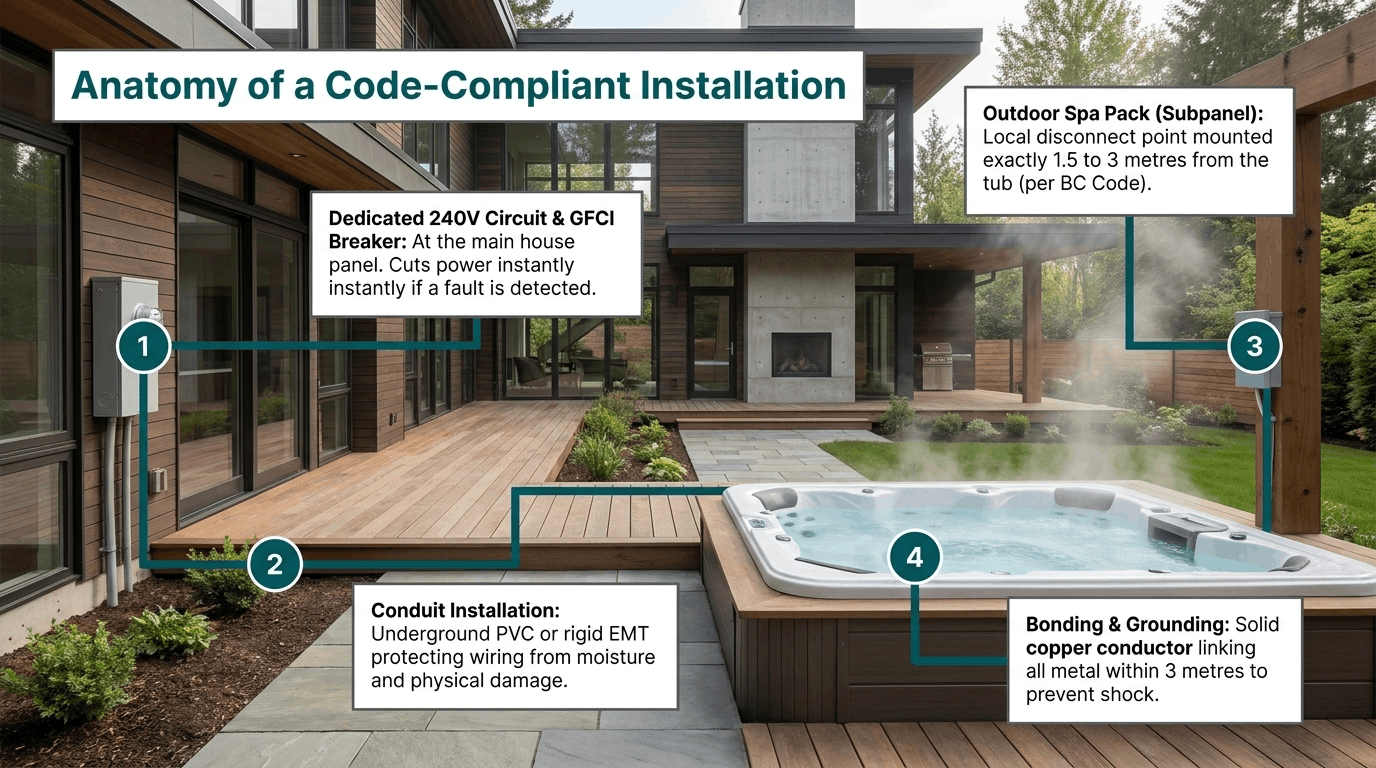
Not all quotes cover the same scope of work, which is exactly why two hot tub electrical installation cost estimates can look so different on paper. Some contractors price the wire run only and leave permits, bonding, and inspection to the homeowner to figure out. A complete, code-compliant installation in BC includes every item in the table below, if a quote is missing any of these, ask why before signing.
| Component | What It Does |
|---|---|
| Dedicated 240V circuit & double-pole GFCI breaker | Provides a clean power source and cuts power instantly if a fault is detected near water |
| Outdoor-rated weatherproof subpanel (spa pack) | Acts as the local disconnect point, mounted 1.5–3 metres from the tub per BC code |
| Conduit installation (EMT or underground PVC) | Protects wiring from moisture, UV, and physical damage, mandatory for outdoor runs |
| Bonding and grounding | Equalizes voltage between all metal components around the tub, preventing shock |
| Electrical permit | Required by BC Safety Authority for all hot tub installations without exception |
| Final inspection and sign-off | Confirms the installation meets BC Electrical Code Section 68 before the tub is powered |
One point worth emphasizing: the permit and inspection aren’t optional extras that a budget electrician can skip. An unpermitted hot tub installation can void your home insurance coverage and create liability issues if something goes wrong. When comparing quotes, confirming that permit fees are included is as important as comparing the labour rate.
At Trigger Electric, coordinating the permit and scheduling the inspection is part of the job, not something we hand back to the homeowner on completion day. If you’re also weighing the broader cost of compliance work on your property, our breakdown of electrical inspection costs covers what BC homeowners typically pay for a full assessment.
What to Expect on Installation Day?
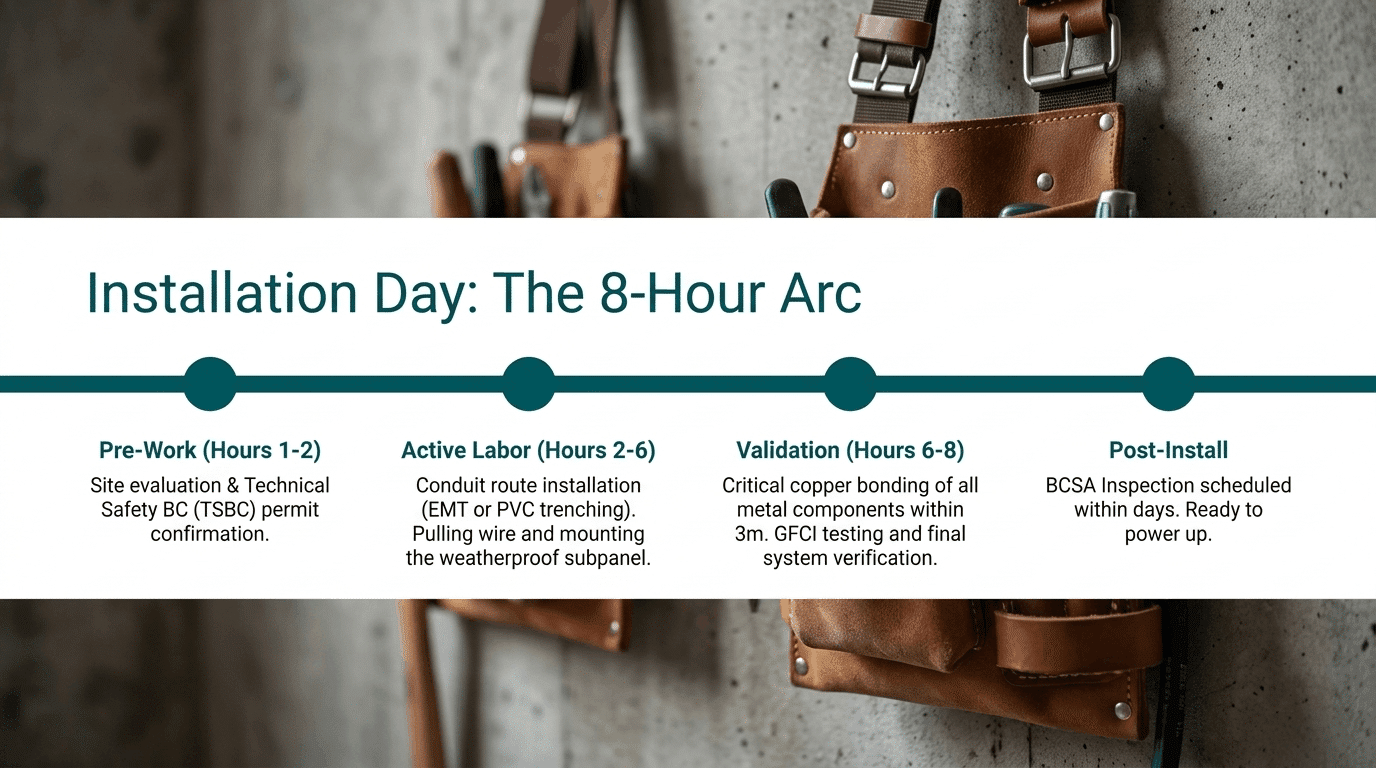
A standard Hot tub electrical installation cost in Metro Vancouver takes six to eight hours from start to finish. Here’s how that time breaks down:
1. Site evaluation
Before any work starts, the electrician assesses the panel, available breaker slots, current load, and service amperage, then maps the best conduit route to the tub location. This step determines whether any surprises, like an undersized panel or a blocked wall cavity, need to be addressed before proceeding.
2. Permit confirmation
Work doesn’t begin until the electrical permit is active. In BC, this is pulled through the Technical Safety BC (TSBC) system. Your electrician handles this, it should never land on you to chase.
3. Conduit installation
Depending on the route, conduit is run above ground using EMT (rigid metal conduit) or buried underground in PVC. Underground runs require a trench dug to the depth required by BC Electrical Code, typically a minimum of 600mm. If trenching crosses finished landscaping or a concrete surface, this is the stage that adds time and cost.
4. Wiring and subpanel installation
The weatherproof subpanel is mounted at the correct distance from the tub, no closer than 1.5 metres per Canadian Electrical Code Section 68. Wire is pulled through the conduit, connected at the subpanel, and run back to the main panel where the new double-pole GFCI breaker is installed.
5. Bonding and grounding
All metal components within 3 metres of the hot tub, including the tub shell, pump housing, and any nearby railings or fixtures, are bonded together with a solid copper bonding conductor. This is one of the most commonly skipped steps in DIY or unpermitted installs, and one of the most important for user safety.
6. Testing and inspection
Before handing over, the electrician tests the GFCI protection, verifies all connections, and confirms the system performs to spec. The BC Safety Authority inspection follows, in most Metro Vancouver municipalities, this is scheduled within a few days of the install. The hot tub should not be powered up until the inspection sign-off is received.
One practical note: have your hot tub in its final position before the electrician arrives. The subpanel location and conduit route are designed around where the tub sits permanently. Moving it afterward means rerouting work that’s already been completed. If you’re still coordinating delivery timing, our page on hot tub electrical installation covers the full system requirements and what to confirm with your tub supplier before booking the electrical work.
Conclusion
Hot tub electrical installation cost in Metro Vancouver varies based on your site conditions, panel capacity, and hot tub model, but the scope of a proper installation doesn’t change. Permit, bonding, inspection, and a dedicated 240V circuit are non-negotiable regardless of where your property sits in that $1,200 to $2,500 range. If your panel is already near capacity, our Panel Upgrade service can be bundled with the hot tub hookup to keep the project on schedule and on budget.