
If you’re pricing out EV charger installation cost Vancouver homeowners are dealing with right now, the short answer is that most jobs land somewhere between $800 and $2,500, but the exact number depends on your panel, your garage layout, and the charger you pick. A straightforward Level 2 install in a newer home with a 200A panel sits at the low end. Add a panel upgrade, a long wire run, or a strata building into the mix, and the cost climbs fast. Below, we break down what actually drives that price, what a licensed electrician checks before quoting you, and where condo and strata owners face a different set of rules. Trigger Electric handles these installs across Vancouver every week, so this is the real pricing picture, not a rough guess.
How Much Does EV Charger Installation Cost in Vancouver?
A standard Level 2 charger installation in Vancouver typically costs between $800 and $2,500 when the panel has enough capacity and the wire run is short. Add a panel upgrade or a long cable run to a detached garage, and the total can reach $3,500 to $4,000.
Here’s how the cost typically breaks down:
| Cost item | Typical range |
|---|---|
| Charger unit (Level 2) | $500 – $1,200 |
| Installation labour (straightforward job) | $300 – $800 |
| Electrical permit (Technical Safety BC) | $75 – $300 |
| Panel upgrade (if your panel can’t handle the load) | $1,500 – $3,500 |
| Long wire run or trenching to a detached garage | $500 – $2,000+ |
The panel upgrade line is what separates a $1,000 job from a $4,000 one. A home with a 200A panel and an open breaker slot usually skips it entirely. A pre-1970s home with a 100A panel that’s already carrying a stove, dryer, and hot tub often can’t take the extra 40 to 60 amp circuit without one.
One detail competitors rarely mention correctly: in BC, the permit for this work isn’t issued by the City of Vancouver. It comes from Technical Safety BC, since electrical permitting is handled provincially, not municipally. Your electrician pulls this permit on your behalf as part of the job.
Level 1 vs Level 2 vs DC Fast Chargers | Which One Do You Actually Need?
Almost nobody installing a home charger in Vancouver actually needs to weigh three options seriously. DC Fast Chargers belong to commercial and public charging stations, the hardware alone costs tens of thousands of dollars and runs on a different voltage class than any residential panel supplies. For a house or condo, the real decision is between Level 1 and Level 2.
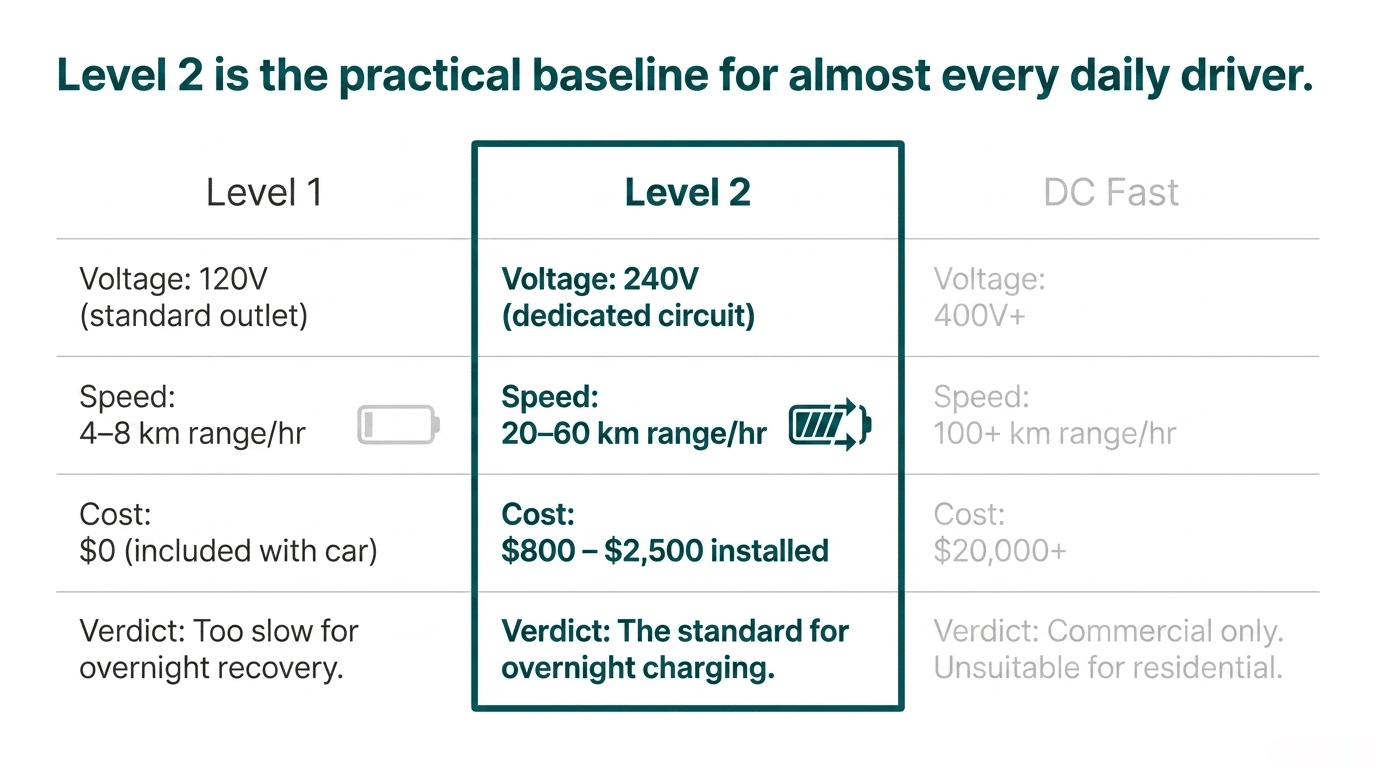
| Level 1 | Level 2 | |
|---|---|---|
| Voltage | 120V (standard outlet) | 240V (dedicated circuit) |
| Charging speed | 4–8 km of range per hour | 20–60 km of range per hour |
| Installation needed | Usually none | Dedicated circuit, professional install |
| Typical cost | $0 (comes with most EVs) | $800 – $2,500 installed |
| Best for | Short daily commutes, occasional charging | Daily drivers, multiple EVs, faster turnaround |
A Level 1 charger is the cord that comes with most electric vehicles. It plugs into a regular wall outlet, which means there’s no installation cost at all, but it’s also slow enough that a full charge can take well over a day. If you drive under 30 kilometres a day and your car sits in the garage overnight regardless, this might genuinely be enough.
For everyone else, that math stops working fast. A depleted battery on a 120V outlet won’t be ready by morning, and there’s no way to speed it up without changing the setup entirely.
Why Level 2 Is the Right Choice for Almost Every Vancouver Home
A Level 2 charger runs on the same 240V circuit as your stove or clothes dryer. That single change in voltage is what takes a charge time of over a day down to a few hours overnight, which is the entire reason Level 2 has become the default recommendation for homeowners rather than a premium upgrade.
The installation requires a dedicated circuit sized to the charger’s amperage, run from your panel to wherever the unit will sit. That’s the only real cost driver here. The charger hardware itself is a few hundred dollars more than a Level 1 unit, but the labour and electrical work around it are what separate a $300 job from a $2,500 one, which is exactly what the rest of this guide breaks down.
What Drives the Final Price Up or Down
No two Vancouver homes get quoted the same number for an EV charger, and it’s rarely about the charger itself. The hardware is a fixed cost. What changes from house to house is the electrical work around it, and four factors account for almost all of that variation.
Electrical Panel Capacity (100A vs 200A)
A Level 2 charger needs a dedicated 40 to 60 amp breaker, and whether your panel can spare that capacity depends on what else is already running off it. A modern 200A panel with an open slot usually absorbs a 40-50A circuit without issue. A 100A panel is a different story, especially in older Vancouver homes already carrying an electric range, dryer, and hot water tank on the same service.
This is where a load calculation matters more than the sticker rating on your panel door. An electrician checks total demand against capacity, not just the number printed on the breaker. Two homes with identical 100A panels can get opposite answers depending on what else draws power in the house.
If you’re trying to figure out where your own panel stands before calling anyone, these 7 questions to ask before a panel upgrade are a good starting point.
| Panel size | Typical outcome for a Level 2 charger |
|---|---|
| 200A with available breaker slots | Usually no upgrade needed |
| 200A, fully loaded | May need a subpanel or load management device |
| 100A, light household load | Sometimes works as-is, pending load calculation |
| 100A, heavy load (range, dryer, hot tub) | Panel upgrade likely required |
Distance Between Panel and Charger
Every metre of wire costs money, and the gap between cost-effective and expensive comes down almost entirely to where your panel sits relative to the parking spot. A charger mounted ten feet from the panel in an attached garage is a same-day job with minimal materials. If you’re routing wire to a detached garage yourself or want to understand what an electrician checks before running that line, our guide on how to safely run wiring for a garage EV charger breaks down what pros look for first.
Indoor installations near the panel sit at the bottom of the cost range. Outdoor or detached-structure installs sit at the top, sometimes adding $500 to $2,000 just in wiring and trenching.
Hardwired vs Plug-In Installation
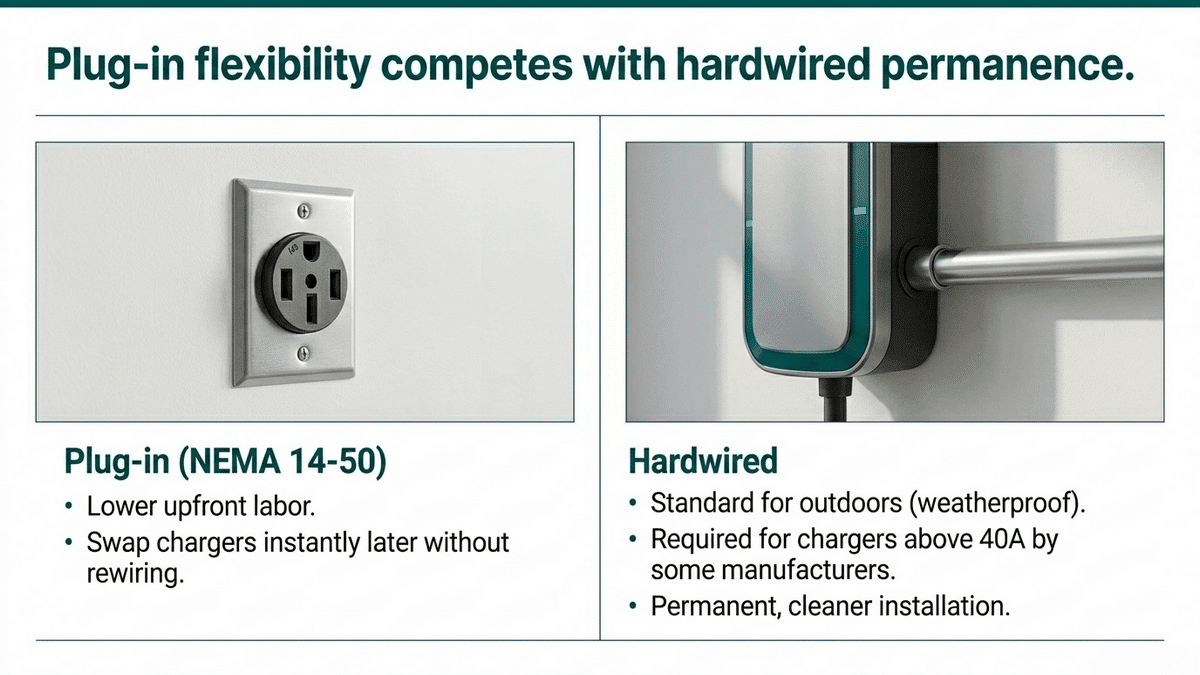
There are two ways to connect a Level 2 charger, and the choice affects both price and flexibility.
- Plug-in (NEMA 14-50): The electrician installs a heavy-duty outlet, and the charger plugs into it like an appliance. Lower install cost, and you can swap the charger later without rewiring anything.
- Hardwired: The charger connects directly to the circuit with no plug in between. Slightly more labour up front, but it’s the standard choice for outdoor installs and for chargers above 40A, since some manufacturers require a hardwired connection at higher amperages.
Neither option is wrong. A plug-in setup suits someone who might upgrade chargers in a few years. A hardwired unit suits someone who wants a permanent, weatherproof installation and isn’t planning to change hardware.
Load Management Devices | An Alternative to a Panel Upgrade
A full panel upgrade in Vancouver runs $1,500 to $3,500. A load management device often costs a fraction of that and solves the same problem from a different angle.
Instead of giving the charger its own slice of permanent capacity, the device monitors what the rest of the house is drawing and throttles the charger when demand spikes elsewhere, then lets it run at full power when there’s headroom. For most households, this is invisible day to day, since the charger does its work overnight when nothing else is pulling power. It’s also the device BC Hydro specifically rebates with an extra $200, precisely because it lets homeowners skip an expensive service upgrade. An electrician will know during the panel assessment whether this is a realistic substitute for your situation or whether the load genuinely calls for more capacity.
Labour Costs and Installation Timeline
A licensed electrician in Vancouver typically bills $95 to $160 per hour for residential work, with most companies charging a service call fee of $100 to $300 that covers travel and the first hour. EV charger jobs rarely run on pure hourly billing though, most electricians quote a flat price for the install once they’ve seen your panel and the wire run, which is why two homes with identical chargers can get very different quotes.
Timeline depends entirely on what the job involves:
- Straightforward install, panel nearby, no upgrades needed: 3 to 6 hours, often finished same day
- Longer wire run or finished walls to route through: 6 to 10 hours, sometimes split across two visits
- Panel upgrade required: add a half day to a full day on top of the charger install itself, plus time for the Technical Safety BC inspection to clear before you can use the charger
Curious what that inspection actually involves or costs? Our breakdown of electrical inspection costs covers it in detail.
The permit and inspection step is non-negotiable and shouldn’t be skipped to save time. A charger installed without a permit can complicate a home insurance claim later, and most BC Hydro rebates require proof of a permitted, licensed install before they’ll pay out.
Condo and Strata EV Charger Installation | What’s Different
Owning a unit in a strata building changes the process even though the electrical work itself is the same. Before any wiring happens, you need approval, and BC law now makes that approval harder for a strata council to refuse outright.
Since amendments to the Strata Property Act took effect, a strata corporation generally can’t unreasonably deny an owner’s request to install EV charging infrastructure once the building has obtained an electrical planning report, or once the deadline to get one has passed. That said, “can’t unreasonably refuse” isn’t the same as “no approval needed.” Council can still attach conditions: who pays for what, which contractor does the work, how the installation gets documented, and what happens if the strata later rolls out a building-wide charging system that makes your individual setup incompatible.
What an owner typically needs before work starts:
- A written request to the strata council, including the charger type, the parking stall location, and distance to the nearest electrical source
- Confirmation of whether the building has spare electrical capacity, or whether the strata’s electrical planning report already addressed EV demand
- Council’s written approval, ideally with any conditions spelled out rather than left informal
- A licensed electrician to handle the installation, permit, and inspection, the same as a single-family home
The cost itself can run higher than a detached house in a few specific ways. Shared electrical infrastructure means the wire run from a parkade stall back to the building’s main service is often longer than a typical garage install, and if the building’s total capacity is already tight, the strata may require a load management system across multiple units rather than approving one-off circuits. On the upside, multi-unit buildings have access to their own rebate stream through BC Hydro and CleanBC, separate from the single-family home rebate, which can offset a meaningful chunk of both the infrastructure and the charger itself.
The one thing worth doing before requesting anything: check whether your strata already has an EV charging bylaw or a sample agreement in place. If it doesn’t, expect the approval process to take longer than the installation itself.
Conclusion
Getting EV charger installation right comes down to two things: an honest panel assessment before you buy anything, and a licensed electrician who pulls the permit and handles the inspection properly. The price swings we’ve covered, from a same-day $800 job to a $4,000 panel upgrade, almost always trace back to what your home’s existing electrical service can and can’t support. If you’re not sure where your panel stands, our panel upgrade service is the right place to start before committing to a charger.